mangos pattern guide
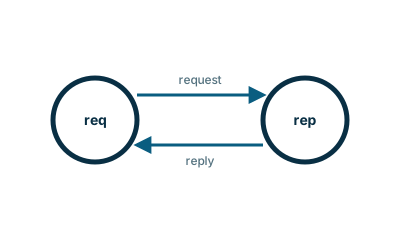
REQ / REP — I Ask, You Answer
REQ / REP pairs a request with the response from a service.
Start in a Go module and install the current major version: go get go.nanomsg.org/mangos/v3. The complete example below is synchronized with the mangos main branch.
reqrep.go
// Copyright 2018 The Mangos Authors
//
// Licensed under the Apache License, Version 2.0 (the "License");
// you may not use file except in compliance with the License.
// You may obtain a copy of the license at
//
//    http://www.apache.org/licenses/LICENSE-2.0
//
// Unless required by applicable law or agreed to in writing, software
// distributed under the License is distributed on an "AS IS" BASIS,
// WITHOUT WARRANTIES OR CONDITIONS OF ANY KIND, either express or implied.
// See the License for the specific language governing permissions and
// limitations under the License.

// reqprep implements a request/reply example.  node0 is a listening
// rep socket, and node1 is a dialing req socket.
//
// To use:
//
//   $ go build .
//   $ url=tcp://127.0.0.1:40899
//   $ ./reqrep node0 $url & node0=$! && sleep 1
//   $ ./reqrep node1 $url
//   $ kill $node0
//
package main

import (
	"fmt"
	"os"
	"time"

	"go.nanomsg.org/mangos/v3"
	"go.nanomsg.org/mangos/v3/protocol/rep"
	"go.nanomsg.org/mangos/v3/protocol/req"

	// register transports
	_ "go.nanomsg.org/mangos/v3/transport/all"
)

func die(format string, v ...interface{}) {
	fmt.Fprintln(os.Stderr, fmt.Sprintf(format, v...))
	os.Exit(1)
}

func date() string {
	return time.Now().Format(time.ANSIC)
}

func node0(url string) {
	var sock mangos.Socket
	var err error
	var msg []byte
	if sock, err = rep.NewSocket(); err != nil {
		die("can't get new rep socket: %s", err)
	}
	if err = sock.Listen(url); err != nil {
		die("can't listen on rep socket: %s", err.Error())
	}
	for {
		// Could also use sock.RecvMsg to get header
		msg, err = sock.Recv()
		if err != nil {
			die("cannot receive on rep socket: %s", err.Error())
		}
		if string(msg) == "DATE" { // no need to terminate
			fmt.Println("NODE0: RECEIVED DATE REQUEST")
			d := date()
			fmt.Printf("NODE0: SENDING DATE %s\n", d)
			err = sock.Send([]byte(d))
			if err != nil {
				die("can't send reply: %s", err.Error())
			}
		}
	}
}

func node1(url string) {
	var sock mangos.Socket
	var err error
	var msg []byte

	if sock, err = req.NewSocket(); err != nil {
		die("can't get new req socket: %s", err.Error())
	}
	if err = sock.Dial(url); err != nil {
		die("can't dial on req socket: %s", err.Error())
	}
	fmt.Printf("NODE1: SENDING DATE REQUEST %s\n", "DATE")
	if err = sock.Send([]byte("DATE")); err != nil {
		die("can't send message on push socket: %s", err.Error())
	}
	if msg, err = sock.Recv(); err != nil {
		die("can't receive date: %s", err.Error())
	}
	fmt.Printf("NODE1: RECEIVED DATE %s\n", string(msg))
	sock.Close()
}

func main() {
	if len(os.Args) > 2 && os.Args[1] == "node0" {
		node0(os.Args[2])
		os.Exit(0)
	}
	if len(os.Args) > 2 && os.Args[1] == "node1" {
		node1(os.Args[2])
		os.Exit(0)
	}
	fmt.Fprintf(os.Stderr, "Usage: reqrep node0|node1 <URL>\n")
	os.Exit(1)
}
Run it
#!/bin/sh
#
# Copyright 2014 The Mangos Authors
#
# Licensed under the Apache License, Version 2.0 (the "License");
# you may not use file except in compliance with the License.
# You may obtain a copy of the license at
#
#    http://www.apache.org/licenses/LICENSE-2.0
#
# Unless required by applicable law or agreed to in writing, software
# distributed under the License is distributed on an "AS IS" BASIS,
# WITHOUT WARRANTIES OR CONDITIONS OF ANY KIND, either express or implied.
# See the License for the specific language governing permissions and
# limitations under the License.

url=tcp://127.0.0.1:40899
./reqrep node0 $url & node0=$! && sleep 1
./reqrep node1 $url
kill $node0
mangos is pure Go. The blank transport import in the example registers the URL transports it uses.